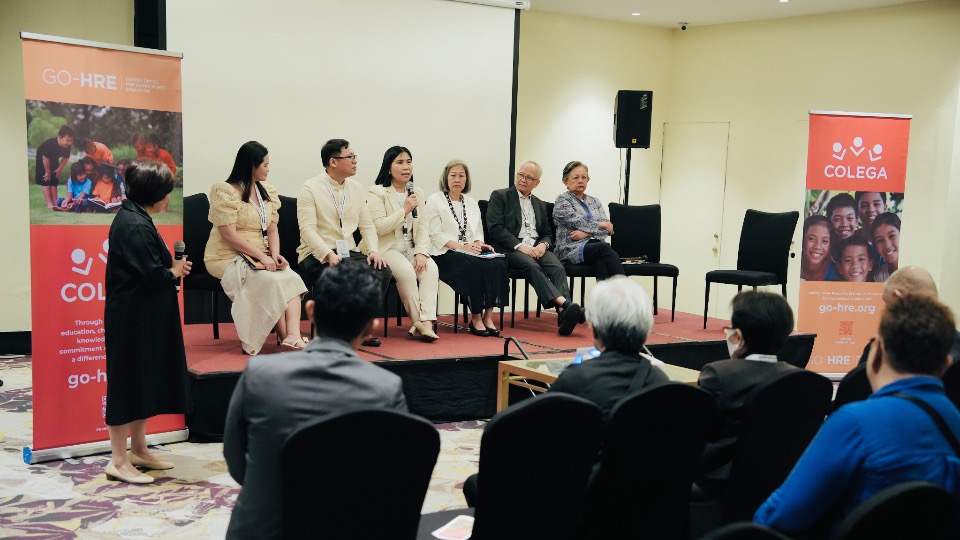
- Speakers engage with participants during the “Teaching Children’s Rights: Building a Culture of Human Rights and Peace Through the Colega Curriculum” side event of the ASEAN Peace Education High-Level Conference, at Crowne Plaza Manila Galleria.
- Participants pose for a group picture during the “Teaching Children’s Rights: Building a Culture of Human Rights and Peace Through the Colega Curriculum” side event of the ASEAN Peace Education High-Level Conference, at Crowne Plaza Manila Galleria.
- Julinda and Djarot Subiantoro (first and second from left) Directors of Latter-day Saint Charities Southeast Asia, speak during the “Teaching Children’s Rights: Building a Culture of Human Rights and Peace Through the Colega Curriculum” side event of the ASEAN Peace Education High-Level Conference, at Crowne Plaza Manila Galleria.
- Djarot and Julinda Subiantoro (first and second from right) Directors of Latter-day Saint Charities Southeast Asia, speak during the “Teaching Children’s Rights: Building a Culture of Human Rights and Peace Through the Colega Curriculum” side event of the ASEAN Peace Education High-Level Conference, at Crowne Plaza Manila Galleria.
- Dr. Joel Potane, a Colega Lead Trainer and Facilitator who serves as the Director for Research, Innovation, and Technology Transfer Services at the City College of Cagayan de Oro, speaks during the “Teaching Children’s Rights: Building a Culture of Human Rights and Peace Through the Colega Curriculum” side event of the ASEAN Peace Education High-Level Conference, at Crowne Plaza Manila Galleria.


| Temple Square is always beautiful in the springtime. Gardeners work to prepare the ground for General Conference. © 2012 Intellectual Reserve, Inc. All rights reserved. | 1 / 2 |
Peace education can begin by helping children understand their own dignity and rights, while learning to recognize and respect the dignity and rights of others.
The above statement is the key idea behind Colega, a human rights education curriculum designed to be understandable, practical, fun, and meaningful for children and young people, and which is supported by The Church of Jesus Christ of Latter-day Saints.
On September 23, 2026, the International Center for Law and Religion Studies (ICLRS) at Brigham Young University (BYU) and the Philippine Center for Islam and Democracy (PCID) hosted a side event titled “Teaching Children’s Rights: Building a Culture of Human Rights and Peace Through the Colega Curriculum” as part of the ASEAN Peace Education High-Level Conference at Crowne Plaza Manila Galleria.
During the event, educators, policymakers, peacebuilders, civil society leaders, and partners from across the region were introduced to the Philippine experience with Colega, as an example of what can happen when educators, institutions, government, civil society, parents, and other partners work together to promote peace education.
Colega (a Spanish word for "friend” or "colleague”) is a non-partisan, non-sectarian educational curriculum created by the Geneva Office for Human Rights Education (GO-HRE) for primary and secondary school children, by teaching the core principles of the United Nations Universal Declaration of Human Rights and the Convention on the Rights of the Child in an engaging and entertaining way.
“Through a formal memorandum of agreement signed with the Secretary of Education, we have created a resource that brings human rights education down to where it matters most: into the hearts, into the hands, and daily lives of learners and teachers,” explained Crisanta Padilla, who serves as Area Director of GO-HRE.
Padilla shared that Colega manuals “teach children their rights to protection, their rights to education, to health, to expression, in a language they can understand, in lessons that respect their culture, and in ways that help them practice peace every single day.”
- A participant interacts with the speakers during the “Teaching Children’s Rights: Building a Culture of Human Rights and Peace Through the Colega Curriculum” side event of the ASEAN Peace Education High-Level Conference, at Crowne Plaza Manila Galleria.
- The venue for the “Teaching Children’s Rights: Building a Culture of Human Rights and Peace Through the Colega Curriculum” side event of the ASEAN Peace Education High-Level Conference, at Crowne Plaza Manila Galleria.
- A participant interacts with the speakers during the “Teaching Children’s Rights: Building a Culture of Human Rights and Peace Through the Colega Curriculum” side event of the ASEAN Peace Education High-Level Conference, at Crowne Plaza Manila Galleria.
- Participants listen to speakers during the “Teaching Children’s Rights: Building a Culture of Human Rights and Peace Through the Colega Curriculum” side event of the ASEAN Peace Education High-Level Conference, at Crowne Plaza Manila Galleria.


| Temple Square is always beautiful in the springtime. Gardeners work to prepare the ground for General Conference. © 2012 Intellectual Reserve, Inc. All rights reserved. | 1 / 2 |
Two professional educators described their experience on how Colega was implemented in a particular school setting.
“Our teachers facilitate learning through songs, through interactive discussions, interactive activities, through dialogues as well,” shared Dr. Joel Potane, a Colega Lead Trainer and Facilitator who serves as the Director for Research, Innovation, and Technology Transfer Services at the City College of Cagayan de Oro.
Dr. Jean T. Loquillano, who is the Director for Extension and Social Services Development Services and Coordinator for the Center for Human Rights Education also at the City College of Cagayan de Oro, relates that “students were provided with enough knowledge in terms of human rights. They know their rights. They also know that they have the right to respect others if they have to consider that one.”
Dr. Amina Rasul-Bernardo, President of the Philippine Center for Islam and Democracy, highlighted the need for parents to reinforce the importance of what children can learn from Colega, based on her childhood experiences growing up in Jolo, Sulu.
“It would also be an ideal situation … if there's a module for the guardians be the principal actors in teaching children about their rights and the rights of the child,” Rasul-Bernardo noted, whose work focuses on peacebuilding, dialogue, and strengthening peaceful and inclusive communities.
Djarot and Julinda Subiantoro, who serve as Directors of Latter-day Saint Charities Southeast Asia, spoke about their experiences with peace education in Indonesia.
The couple recommends that peace educators “partner with a local champion to understand the norms and values in the community … [and] customize [Colega] to match with the developmental stage of the children in that community,” as a way to “respect the culture, the way of life of the community.”
Participants were also invited to connect with the speakers to learn more about the Colega curriculum and explore opportunities for collaboration, and were also provided with opportunities to receive Colega resource materials.